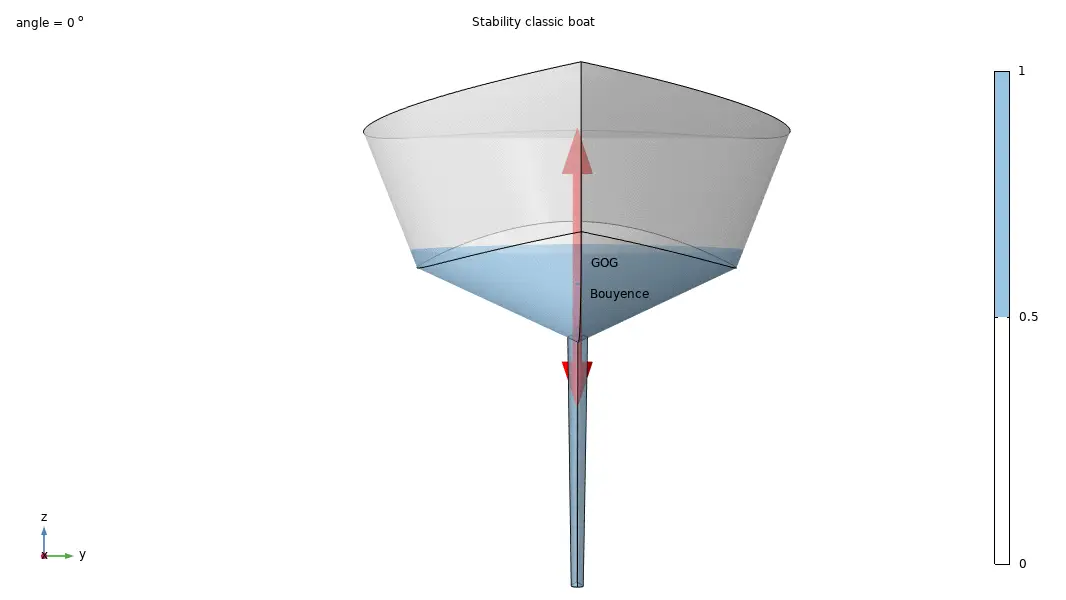
Here some marine applications are shown with advanced simulation techniques within Comsol. A very important application is the determination of the stability of a ship or hull. These simulations are able to determine the stability curves.
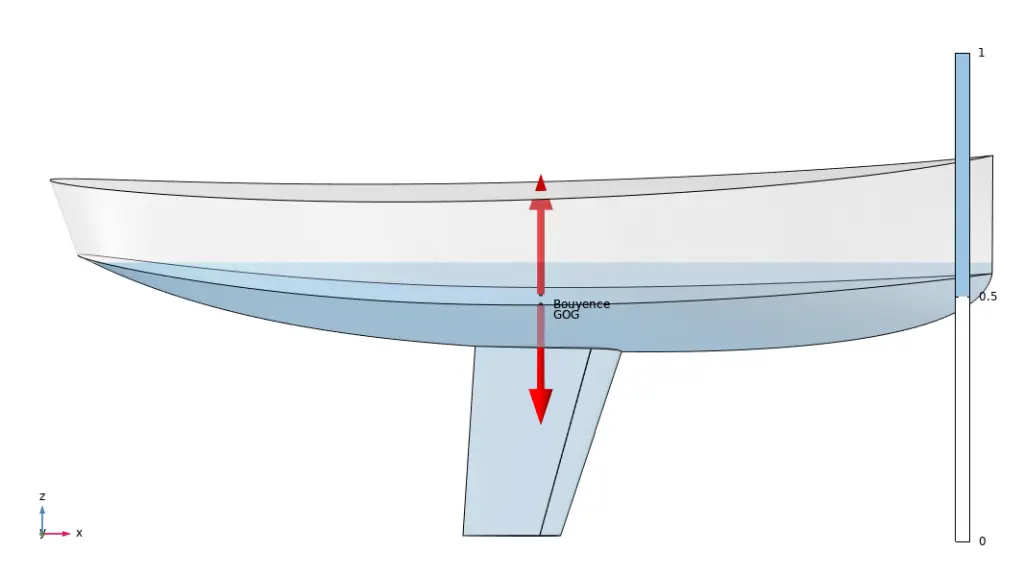
Given the shape of a hull and the mass distribution of all internal components, such as hull thickness, location of motor, kichen and very important the keel, a stability simulation can be performed of the ship.
First the waterline level should be determined, and the red arros indicate the Buoyance force and the gravity force. They are in equilibrium. Then the stability calculation results in the stability curve.
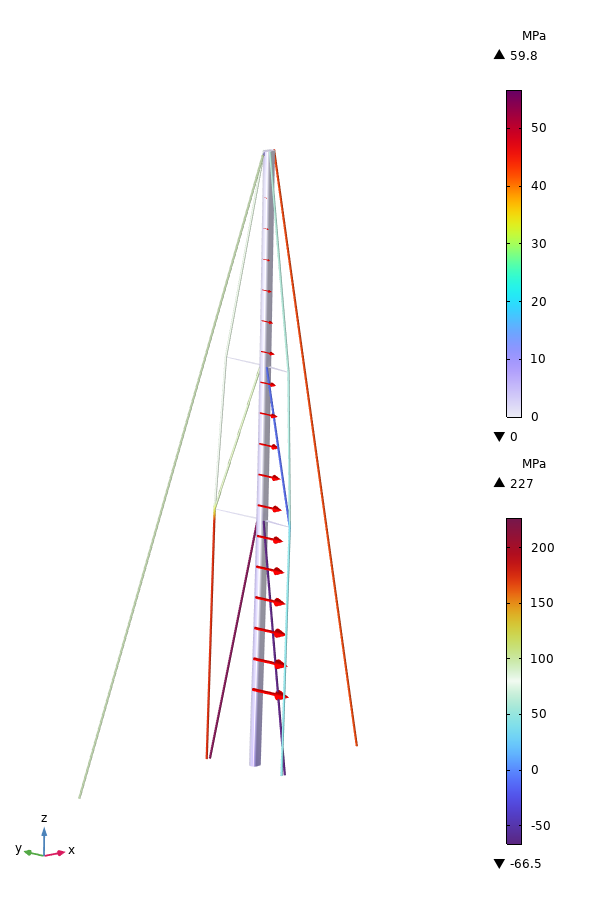
Forces on masts should be designed in order to withstand the forces of the wind even under severe conditions. The system is designed according the bla bla. The arrows in the figure represent the forces from the main sail, and should be understood in this picture as an illustration. Of course all sails attached to the rigging system induce forces, for example the jib, main sail etc. At the right a color scale is visible and the top one applies to the colors of the mast. The bottom scale applies to the colors of the steel cables.
The mast is build using shell elements, with quadratic Langrange polynomials. The Cables use wire elements with Linear Langrange polynomials, with an additional condition to stay straight when the cables might hang loose under certain conditions (compression).
All these settings add to an robust and reliable output of the stresses and displacements in the rigging system.