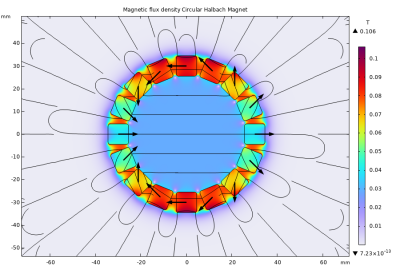
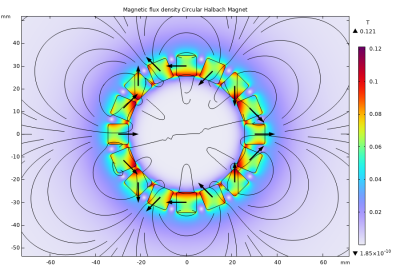
Circular Halbach magnets rotate the direction of the magnetization of the elements. In the figure to the right the black arrows represent the magnetization of the different elements and by doing so in a systematic way one can achieve a homogeneous magnetic field inside the ring. The top image represents this situation. By inverting the magnetization, or change the orientation of a few elements the strength of the magnetic fields flip to the otherside, or inverted. The bottom imges shows this situation. One can imagine that many configurations can generate special B_field behaviour. In 3D this might become even more complex, by introcucing the z-axis in the systematic orientation of the magnetization of the magnets.
Inverted Circular Halbach Magnet for High Application
Halbach Array Simulation
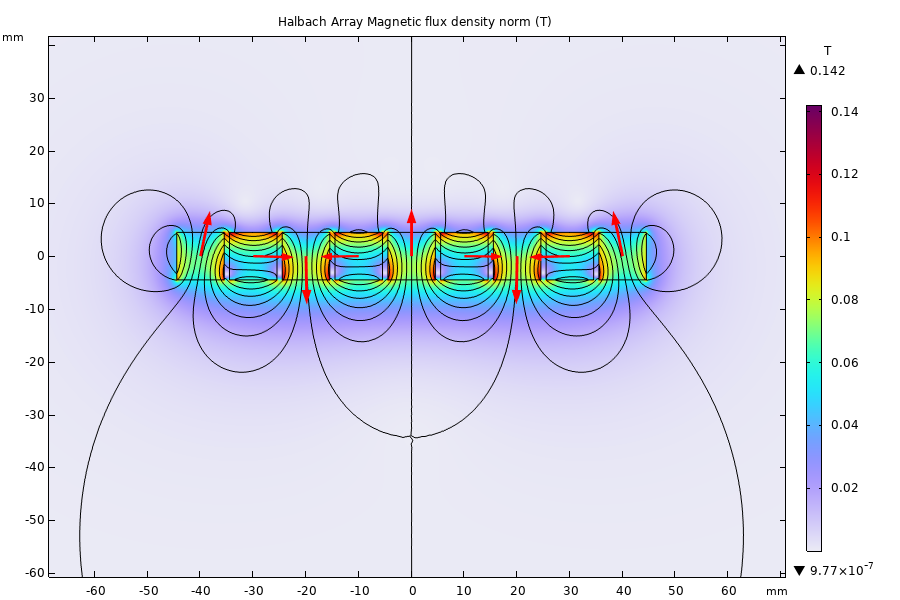
A Halbach array arranges permanent magnets so the field concentrates on one side while nearly cancelling on the other. This asymmetry makes Halbach configurations attractive wherever a strong, well-defined field is needed in a compact space — sensors, motors, magnetic couplings and levitation systems are common applications. COMSOL simulation predicts the field distribution for a given magnet arrangement before any hardware is built, so different orientations, segment counts and array geometries can be compared on paper first. To the left an image is shown of a linear array and it is clear from this image that the strongest magnetic field can be found at the bottom side of the magnet.
Depending on the application, the array may be stationary or in motion — for example, rotating in a motor or moving relative to a sensor. Both static and dynamic simulations are used to describe how the field behaves under these conditions, giving a realistic picture of performance before the design is finalized.
Field Strength and Orientation
The performance of a Halbach array depends on the number of magnet segments, their individual orientation, and the material’s remanence and coercivity. Small changes in segment count or angle can shift both the peak field strength and how sharply the field falls off on the shielded side. Multiphysics simulation makes it possible to test these variations quickly and identify which configuration best matches the target field profile for your application.