Buoyancy-Driven Chimney Flow Simulation
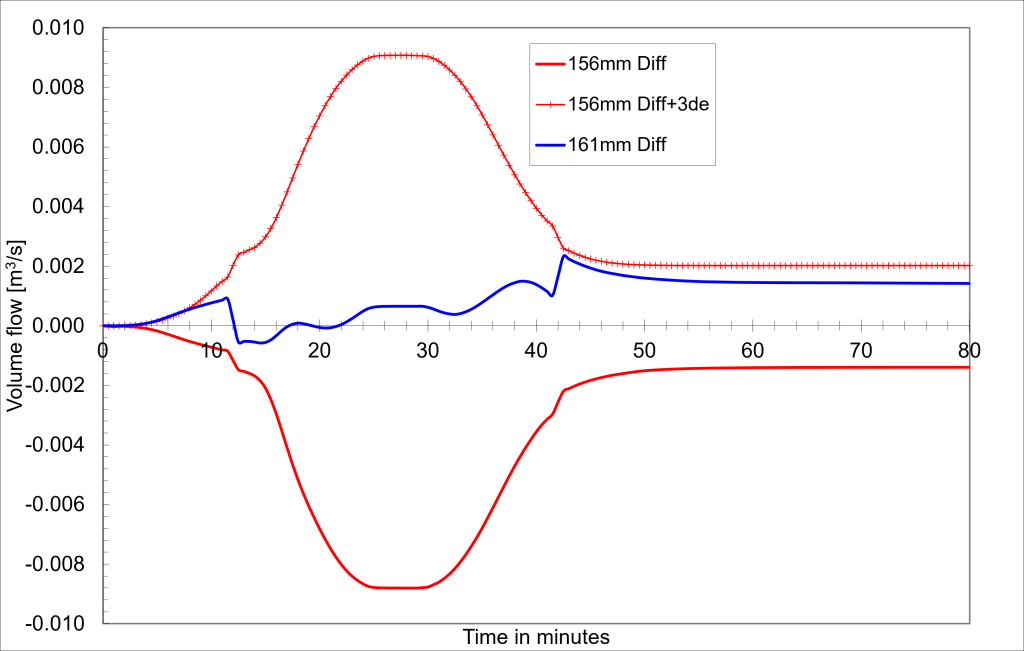
This is another example of Predictive design with CFD in practical situations, where flow, high-temperature chemistry and heat transfer interact within a single model. For challenges like these, our multiphysics COMSOL simulation services combine the relevant physics into one validated model. With very long chimneys in apartment buildings, flow reversal of the flue gas can occur in autumn and spring. This is an undesirable situation and depends on weather conditions. The assignment was to make a time-dependent simulation using CFD (Computational Fluid Dynamics) flow calculations and to come up with proposals to adjust the design so that the flue gas discharge can be guaranteed without flow reversal. Crucial is the geometry of the chimney in terms of inner and out diameter including the thermal isolation in some parts of the chimney.
Why does flow reverse in a chimney?
Long chimneys in high buildings are connected to several appartments. During night the air in a chimney comes to rest. Especially in European countries in autumn or spring, when the average temperatures are about 15 to 20 degrees. On a flat roof, when radiation in cold nights the air temperature can drop significantly and becomes more dense. If there is no wind, and the temperatures are low one can notice the effect of flow reversal in long chimneys. When early in the morning, during flow reversal, a shower is taken the gas-fired central heating produces exhaust gases, sensors notice in the channels higher concentrations of exaust gases and an alarm shuts the central heating system down.
Physixfactor conducted a flow analyses and took into account the density differences of the gases in the chimney and the cooled air on the roof. It was possible to exactly find the cause of why sometimes in autumn or spring a fault was detected.

Flow Reversal Driven by Buoyancy and Natural Convection
Flow reversal in a chimney can occur when temperature differences create buoyancy-driven flow that changes the direction of the air movement. As the fluid is heated, its density changes, generating buoyancy forces that can drive the flow through the chimney. The resulting flow pattern depends on the temperature distribution, geometry and surrounding flow conditions.
This makes the problem particularly interesting from a CFD and natural convection perspective. Rather than imposing a prescribed flow direction, the flow can develop as a consequence of the coupled interaction between temperature, density and velocity fields.
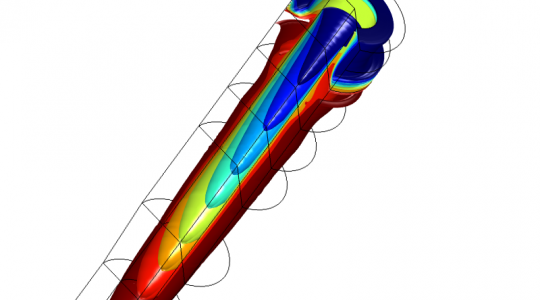
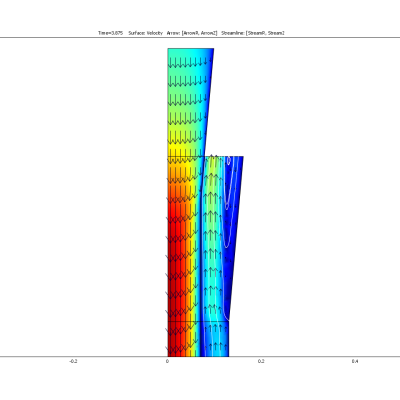
The COMSOL simulation can be used to investigate this interaction in detail. The calculated temperature and velocity fields show where the flow accelerates, decelerates and eventually changes direction. This provides insight into the mechanism responsible for the flow reversal and helps determine how operating conditions or geometric changes influence the resulting airflow.
For chimney and ventilation systems, understanding buoyancy-driven flow and natural convection is important for predicting ventilation performance, heat removal and possible flow recirculation. CFD modelling provides a way to analyse these effects before modifying or building the physical system.
Chimney simulation
The thermal flow analyzes provided insight into the upward forces of the flue gases, which also depend on the diameter of the chimney. The improved chimney no longer shows backfire, and operation can now be guaranteed in autumn and spring. Some adjustments were also proposed in the start-up cycle of the central heating boilers, all of which contribute to improved functionality. This represents a significant saving on maintenance costs, and especially on malfunction reports.