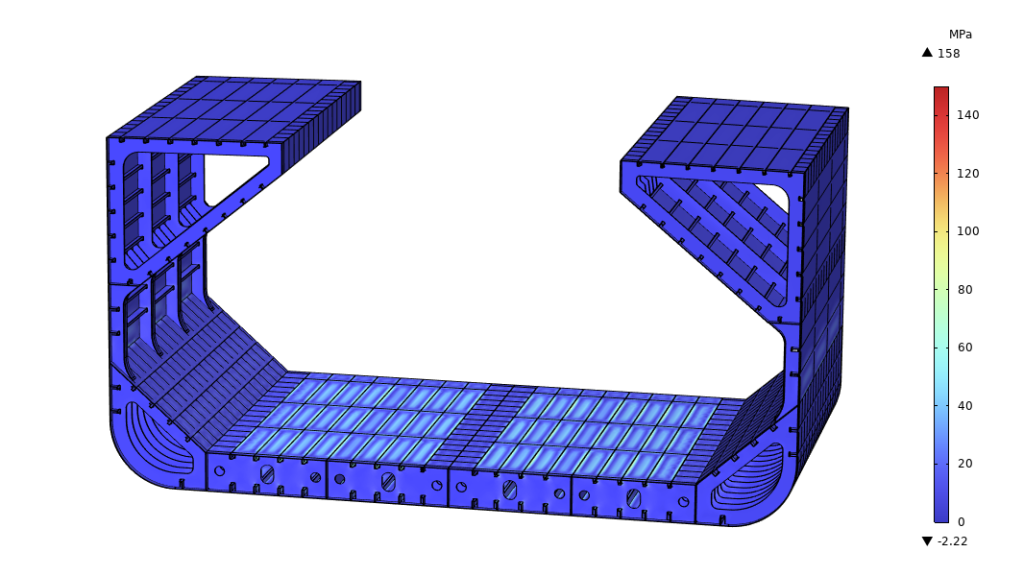
Computational dynamics of the mid-ship of a bulk carrier. Most of the time the bulk consists of a granular material. In the picture to the right an impression is shown of the stress in the mid-ship. On the outside of the hull the water pressure as a function of the depth to the waterline is taken into account. The simulations reveals the loading and unloading of the mid part of this bulk carrier, which serves as a starting point to include other parts of the ship.
Computational Fluid Dynamics (CFD) can be used to analyse water flow around a ship hull and predict its hydrodynamic performance. By simulating the flow around the hull at different speeds, important parameters such as flow patterns and hydrodynamic resistance can be evaluated during the design process.
CFD simulations can therefore help optimise hull geometry and reduce resistance, improving the efficiency and performance of a ship.
Physixfactor uses COMSOL Multiphysics for advanced CFD modelling of marine and industrial flow problems.
Hull Design
The hull geometry can be developed in a suitable CAD environment and subsequently evaluated using CFD. Different hull designs and operating speeds can be compared to understand their effect on the surrounding flow and hydrodynamic resistance. Part of the simulations consisted of the so called Fluid Structure Interaction. This is a very important application when the (dynamic) waterpressures cause shell displacements for example in the hull or other part of the construction.
CFD Resistance
CFD makes it possible to investigate the resistance of a ship hull at different speeds. The simulation provides insight into the flow field around the hull and helps identify areas where the design can be improved.