Independent COMSOL Consultant for complex engineering problems
Physixfactor is an independent COMSOL consultancy based in the Netherlands. As a certified COMSOL consultant, we companies solve complex engineering problems using COMSOL Multiphysics from individual simulation studies to long-term COMSOL consulting.
Our experience covers heat transfer, CFD, structural mechanics, electromagnetics, plasma and custom PDE modelling. We work directly with engineers and R&D teams when special COMSOL expertise is required, whether you need help with an existing model, a new simulation, or need to outsource COMSOL simulation.
Complex simulations often require more than knowledge of the COMSOL software itself. The physics, mathematical formulation, numerical methods and modelling assumptions determine whether a simulation produces a useful engineering result.
As an independent COMSOL consultant, we can support your project with both the underlying engineering physics and the COMSOL implementation. This includes developing models from scratch, improving existing simulations, investigating convergence problems and implementing custom PDE formulations when the standard COMSOL interfaces are not sufficient.
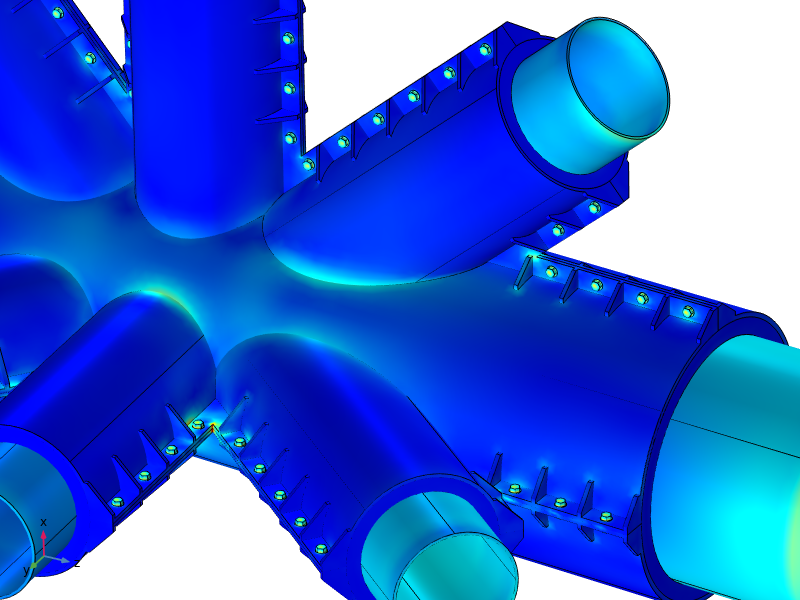
Offshore stress determination
Complex Geometry and Submodeling
Large industrial systems often contain critical regions that require significantly higher accuracy than the overall model.
Physixfactor applies submodeling techniques to efficiently capture local stresses, temperatures, deformations and field concentrations without excessive computational cost.
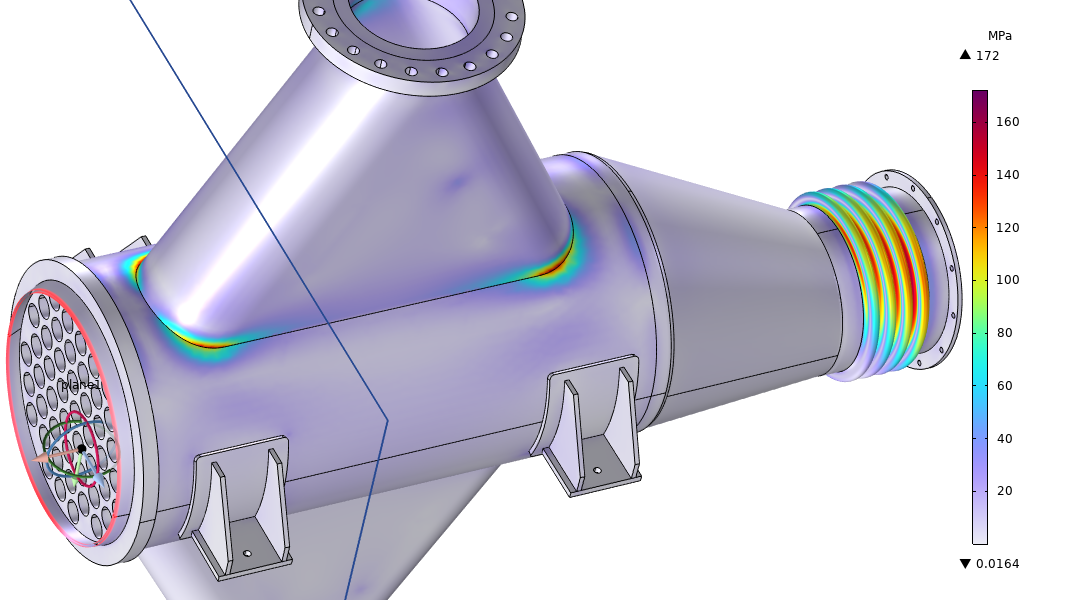
Offshore submodeling example: Submodelling of an offshore bracket was completely outsourced to Physixfactor for comsol consulting. First the geometry and mesh was modefied in order to make a robust model with adequate convergence. We applied the submodelling techique and identified a critical stress concentration that was missed in the global model. Design was modified before production, preventing a potential field failure.
Modal Analysis and Dynamic Behaviour
Resonance-related failures are among the most costly and preventable problems in mechanical engineering. Understanding dynamic behavior early — before a prototype is built — saves weeks of testing and redesign.
Physixfactor performs modal and vibration analyses to identify natural frequencies, mode shapes and structural response to dynamic loading. Applications include machinery, offshore equipment, support structures, piping systems and mechanical assemblies.
What modal analysis reveals:
Natural frequencies and Mode shapes
Resonance risks under operational loading
Dynamic response to seismic or impact loading
Rotating machinery dynamics
EXAMPLE RESULT:
Resonance identified in a pump assembly at 47 Hz, coinciding with operational speed. Geometry adjusted in simulation — problem solved before manufacturing.
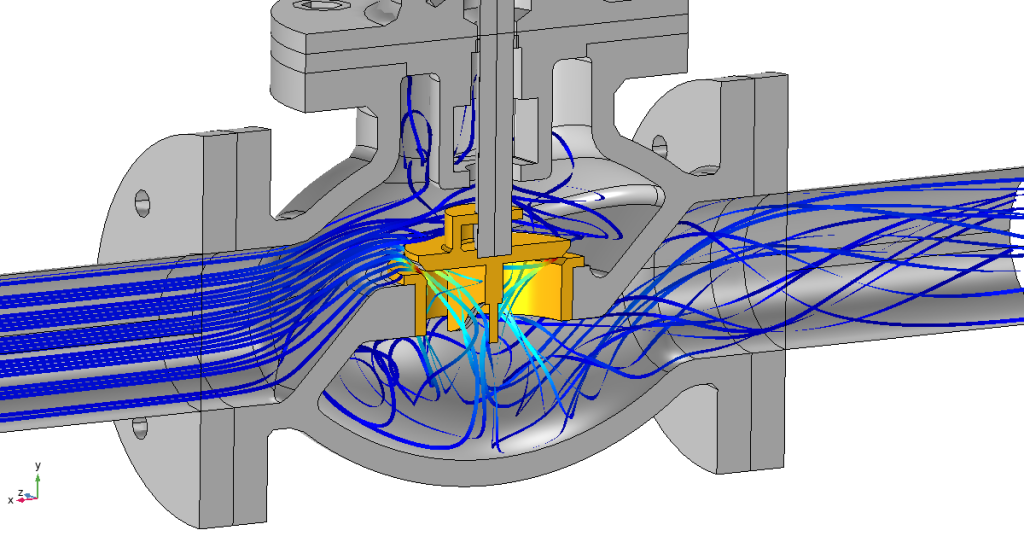
Resonance through turbulent flow in Valve
Multiphysics simulation consultant
Not every engineering problem fits within standard simulation interfaces. Some applications require implementation of proprietary material behavior, custom transport equations or specialized governing equations that no commercial module provides out of the box. For example proprietary sail tuning geometries have been written in order to simulate the Fluid-structure interaction for a sailing yacht sail and rig, we combine aerodynamic CFD with structural response in a single coupled model. [See the sail CFD case →] Physixfactor can help you to solve yours models or support with extensive experience when you are in a need to handle large models with a very high number of boundary conditions. Outsourcing your models can speed up your project and shorten the time to market for your products.
Physixfactor develops custom mathematical models using COMSOL’s advanced equation-based capabilities. This extends simulation possibilities well beyond standard software modules and is particularly valuable for R&D organizations developing novel materials, processes or devices.
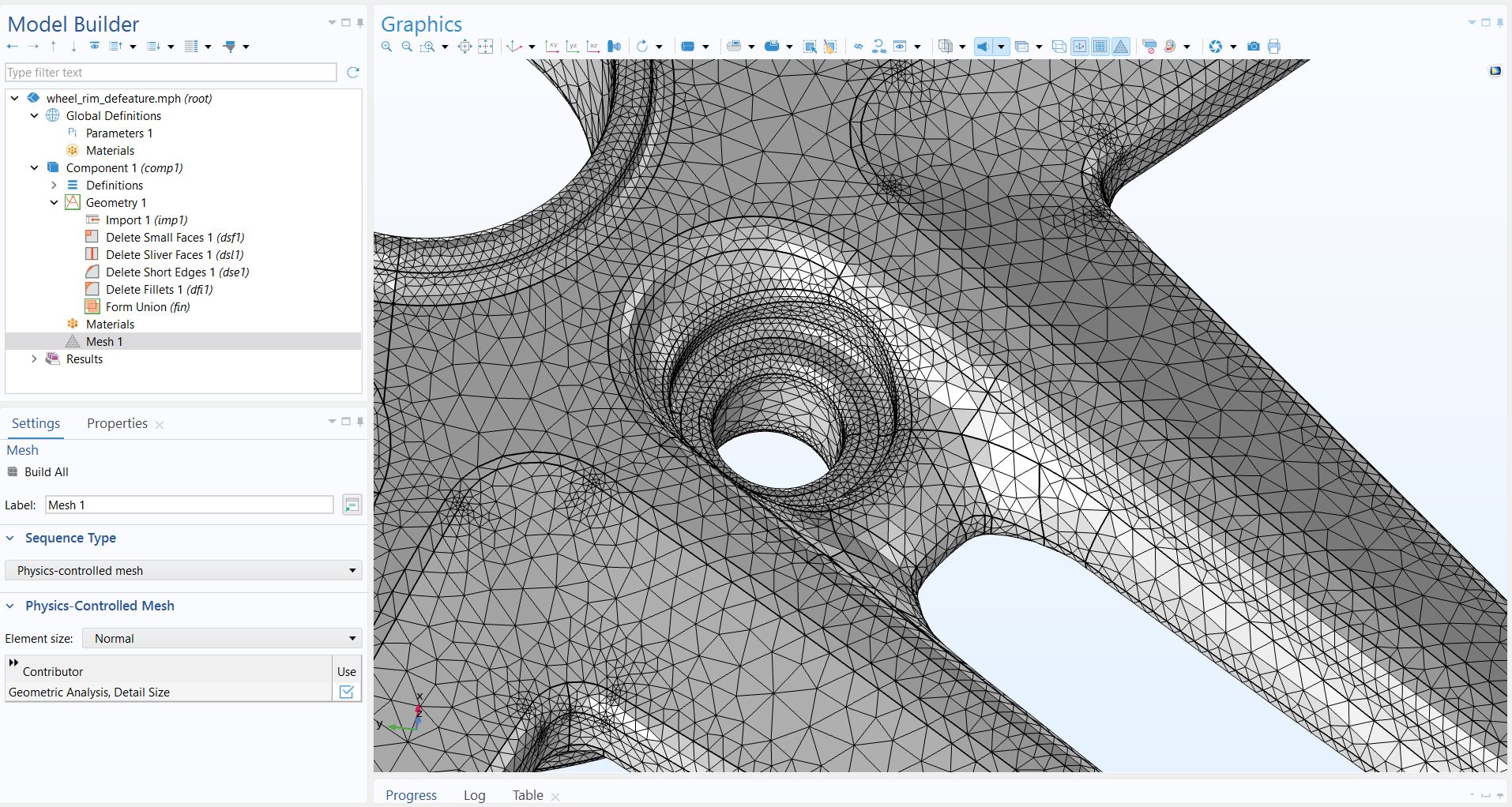
A simulation result is only useful if you can trust it. Common pracrice within the workflow of Physixfactor is a mesh test with a solution that converges in closer steps to the true mathematical solution. One has to understand that Finite Element Methods always are an approximation to the ideal mathematical solution. Once you understand this mechanism you can produce results which give you confidence in the next steps to take in your project.
Every project which is outsourced, includes systematic quality checks as standard practice, not as an optional add-on.
Verification procedures:
Mesh independence studies
Convergence testing and Solver sensitivity analysis
Boundary condition verification
Solver convergence checks
Validation against analytical solutions where applicable
Engineering plausibility reviews
Physixfactor places strong emphasis on model credibility and traceability. Simulation results should not only converge numerically but must also remain physically meaningful. In other words, your next steps in the project will be succesful!
Mesh example for FEM analysis
Industries Served, Comsol outsourcing
Physixfactor supports companies and research organizations across a range of industries where physics simulation is critical to product quality and engineering reliability. Outsourcing your Comsol projects
Physixfactor is an independent COMSOL Certified Consultant with 20+ years of experience in engineering simulation and finite element analysis. Physixfactor combines advanced COMSOL expertise with a strong mathematical and engineering background. Physixfactor meets the quality standards set by COMSOL AB for simulation accuracy, model credibility and client communication.
Advanced multiphysics expertise across all major physics disciplines
Experience with complex, large-scale industrial models
Custom equation-based modeling capabilities
Rigorous verification and quality assurance as standard
Practical engineering interpretation — results you can act on
Our objective is to deliver simulation models that are robust, credible and useful for real engineering decisions.
Ready to Solve your Simulation challenge?
If your project involves challenging multiphysics behavior, complex geometries, advanced numerical modeling or validation of existing COMSOL models, Physixfactor can help. Outsource your COMSOL modeling to Physixfactor.