MEMS resonator

Micro-electro-mechanical systems, or MEMS resonators for short, are small systems in silicon substrates that consist of a combination of electronic and mechanical components. All components of a MEMS are placed on a silicon substrate using lithographic techniques. The MEMS resonators at NXP (former semiconductor division of Philips) are manufactured via “micromachining” processes, which use technologies also used to fabricate integrated circuits (ICs). During IC manufacturing, wafers with MEMS structures undergo many process steps. Each step produces a greater or lesser variation of the product. All these variations were simulated and a thorough insight was obtained into the stable operation of the MEMS.

Dogbone MEMS

MEMS resonator eigenfrequency

Various MEMS components are manufactured at NXP in Nijmegen. Microresonators are seen as the successor to the old crystals that control electronic components via a clock frequency. The demands placed on these products are of course high, for example the frequency must not vary with temperature and it must also remain stable during their lifespan. . The complex multi-physics simulations resulted in a set of specifications for the production environment, so that the products can be produced with a low failure rate.

Stray patterns around capacitive driven Mems resonator

Capacitive behavior of a MEMS resonator is very important for the operation of the product under all kinds of conditions. On the right is an impression of the electric field lines between the parts of a MEMS resonator. In the gap the field lines are more or less straight, but atv the edges stray fields are visible, inducing a slight non-linear behavior when the resonator is driven. 
Anchor losses in a Mems resonator

NXP.001

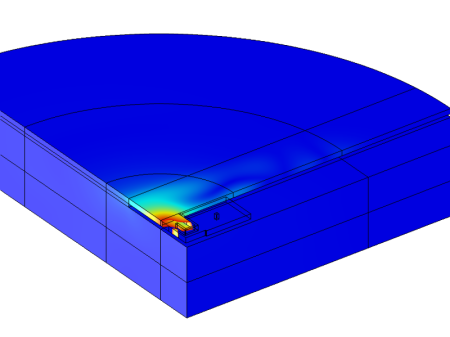
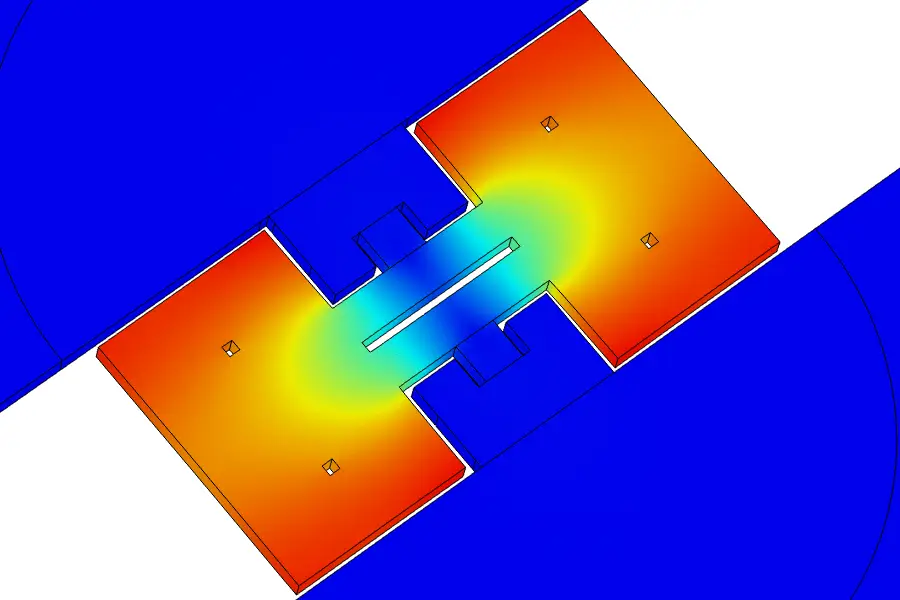
Designing an efficient Mems resonator is very important. Losses of the anchor of the resonator should be designed in order to be minimized. In the figure to the left the intensity of the vibration energy is shown, to get an impression where in the structure the losses occur, or the vibration energy is distributed throughout the structure. It is also important to study possible side modes in order to stay away from this. The structure to the left is a so called dogbone and we have studied all the modes and side modes including the anchor losses. Because the resonator is driven with electrical fields the forces on the dogbone are not linear anymore. Also this has been studied with COMSOL Multiphysics software.