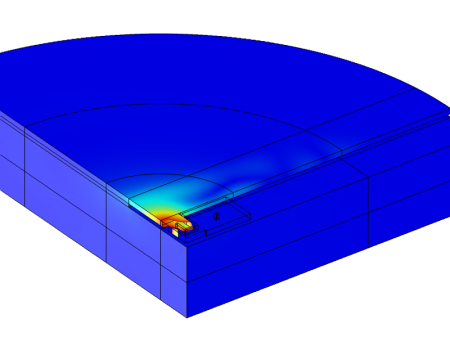
Thermal simulation of IC structures

In a modern chip, many components generate heat in a very small volume. The temperature that results depends on the layout, the materials and the way heat leaves the package, and it is difficult to measure inside the chip. A thermal model in COMSOL shows where the heat is generated, where it flows and where the hot spots appear, before a prototype is built.

thermal simulation IC device

Why thermal behaviour matters

  • Hot spots reduce the lifetime and reliability of components.
  • Temperature differences cause thermal stress in the chip and the package.
  • Heat from one component affects its neighbours.
  • The package and the board determine how fast heat leaves the chip.
  • Heat generation by chip components and heaters [check]
  • Heat conduction through silicon, oxide, metal layers and package
  • Heat exchange with the surroundings
  • Steady-state temperature maps and transient behaviour, such as warm-up time
  • Optional coupling to thermal stress, see the wire bonding project

Stray patterns around capacitive driven Mems resonator

Capacitive behavior of a MEMS resonator is very important for the operation of the product under all kinds of conditions. On the right is an impression of the electric field lines between the parts of a MEMS resonator. In the gap the field lines are more or less straight, but atv the edges stray fields are visible, inducing a slight non-linear behavior when the resonator is driven. 

Anchor losses in a Mems resonator

NXP.001

Designing an efficient Mems resonator is very important. Losses of the anchor of the resonator should be designed in order to be minimized. In the figure to the left the intensity of the vibration energy is shown, to get an impression where in the structure the losses occur, or the vibration energy is distributed throughout the structure. It is also important to study possible side modes in order to stay away from this. The structure to the left is a so called dogbone and we have studied all the modes and side modes including the anchor losses. Because the resonator is driven with electrical fields the forces on the dogbone are not linear anymore. Also this has been studied with COMSOL Multiphysics software.