MEMS resonator simulation: frequency stability in production

MEMS resonators are small silicon structures that combine mechanical and electrical components. They are made with the same lithographic techniques as integrated circuits and are seen as the successor to quartz crystals as clock sources. For a project in the NXP production environment in Nijmegen, we simulated how process variation affects these devices. The result was a set of specifications that allows production with a low failure rate.

Dogbone MEMS

Frequency stability and eigenfrequency

Various MEMS components are manufactured at NXP in Nijmegen. Microresonators are seen as the successor to the old crystals that control electronic components via a clock frequency. The demands placed on these products are of course high, for example the frequency must not vary with temperature and it must also remain stable during their lifespan. . The complex multi-physics simulations resulted in a set of specifications for the production environment, so that the products can be produced with a low failure rate.


The resonance frequency must not drift with temperature and must stay stable over the product’s lifetime. Every wafer-processing step adds some variation to the geometry. We simulated these variations in COMSOL and gained a thorough insight into what keeps the resonator stable.

Capacitive drive and stray fields

The resonator is driven by an electric field. In the gap the field lines are nearly straight, but at the edges stray fields appear. They make the force on the resonator slightly non-linear, which affects behaviour under real operating conditions. We included this effect in the multiphysics model.


Capacitive behavior of a MEMS resonator is very important for the operation of the product under all kinds of conditions.
Anchor losses

NXP.001
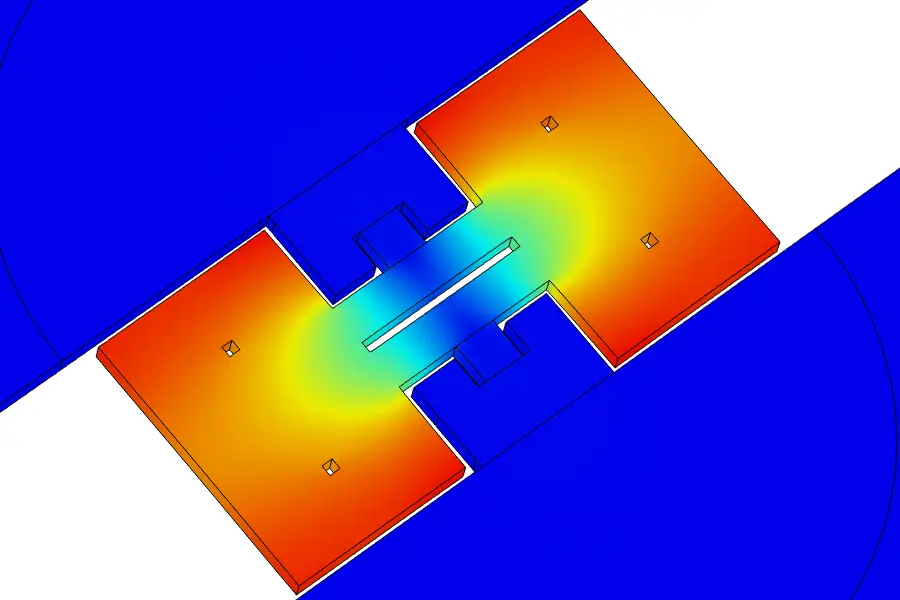
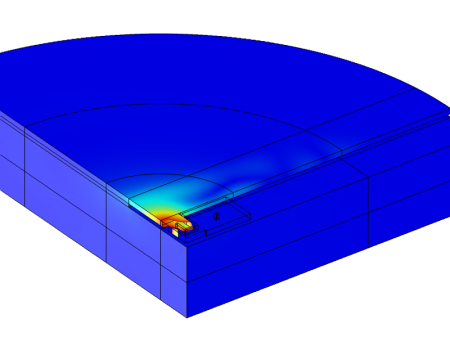
Vibration energy in a dogbone resonator; the Perfectly Matched Layer absorbs the energy leaving through the anchor.

A resonator loses energy where it is attached to the substrate. In the model, a Perfectly Matched Layer absorbs the outgoing vibration energy without reflections, so we can see where the losses occur. For the dogbone resonator we studied all modes and side modes, including the anchor losses, so that the design keeps a safe distance from unwanted modes.